Tampilkan postingan dengan label Shooter. Tampilkan semua postingan

Senin, 28 November 2011

Battlefield 3 Story and Review PS3

Battlefield 3 (commonly abbreviated to BF3) is a first-person shooter video game developed by EA Digital Illusions CE and published by Electronic Arts. The game was released in North America on October 25, 2011 and in Europe on October 28, 2011 for Microsoft Windows, PlayStation 3, Xbox 360[4] and EA Mobile confirmed a port for the iOS platform. It does not support versions of Windows prior to Windows Vista as the game only supports DirectX 10 and 11. It is a direct sequel to 2005's Battlefield 2, and the eleventh installment in the Battlefield franchise. The game sold 5 million copies in its first week of release, and was released to critical acclaim from most game reviewers. The PC download is exclusive to EA's Origin platform, through which PC users also authenticate when connecting to the game. In campaign mode, players take on the personas of various military roles; including a special forces soldier, an F-18 systems officer, and a SPETSNAZ operative. The campaign takes place at various locations, including Iran, and follows the story of Sergeant Blackburn and later, Dimitri Mayakovsky.

Story

Set in 2014,[26] SSgt Blackburn leads a five-man squad on a mission to locate, find and safely return a US squad investigating a possible IED, whose last known position was a market controlled by a hostile militia called the PLR. Blackburn and his squad are later sent to Tehran to apprehend a the leader of the PLR, Al-Bashir. While investigating an underground vault in the target's suspected location, Blackburn and his team learn that the PLR acquired Russian portable nuclear devices, and that two of the three devices are missing. Being overrun, and requesting back-up, an M1 Abrams convoy led by Sergeant Miller is deployed to extract Blackburn's team. Miller facilitates Blackburn's helicopter extraction, but is captured when waiting for a Quick Reaction Force. Miller is promptly executed by Solomon and Al-Bashir, with the event being filmed.


Left with no other option, Blackburn and surviving squad member Montes break out of captivity to stop the attack in New York. Solomon shoots Montes, but Blackburn manages to kill Solomon in the resulting melee, as well as recovering the last nuclear device. In the epilogue, having been diagnosed with radiation poisoning, Dima writes about the efforts of both him and Blackburn to stop Solomon's plot. He then readies his gun when a knock is heard at his door.

Review

When shells are kicking up dust all around, and bullets are sparking off the rocks ahead, you don’t stop to process a little thing like a box no exploding when you shoot it. Pace hides a multitude of technical niggles, and Battlefield 3’s Operation Guillotine mission moves at terrifying lick, catapulting players down a slope towards MG nests and mortar batteries. Between the goons tumbling over sandbag walls at coaxing of a grenade, the ratatat of radio chatter and an onslaught of new guns, it’s possible to miss the jaggies on graffiti-plastered walls or the odd outcrop of blocky foliage.

            Only later, with another player watching the door in co-op mission Ex-filtration, are able to pick at frayed edges-smashed bulbs that still give light, guards that get stuck on low obstacles. It’s a very handsome game nonetheless, and the usual allowances should be made for pre-release code, but anybody expecting Battlefield 3 on console the best those maxed-out marketing shots will be disappointed 

Battlefield 3's Frostbite 2 engine delivers great visuals. It doesn't evolve as far beyond Battlefield: Bad Company 2 as its PC cousin does, but the use of light and dark, smoke, fire, and smudged lens flares consistently impresses. The facial features of your fellow soldiers during campaign, the ocean surging around an aircraft carrier, the fluorescent-lights of nighttime cities, and the wrecked debris of entire buildings brought down all look great. Certain textures take a moment or two until they smooth over, but overall Battlefield 3 performs admirably. 

The engine isn't perfect by any means. I encountered prone legs jutting through walls, tears flickering across solid surfaces, saw snipers half-buried in mountainsides, and bits of green flashing across the screen. I've seen trees planted in midair, noticed AI soldiers in their shooting position long after death. These glitches are annoying, but they don't break the game.
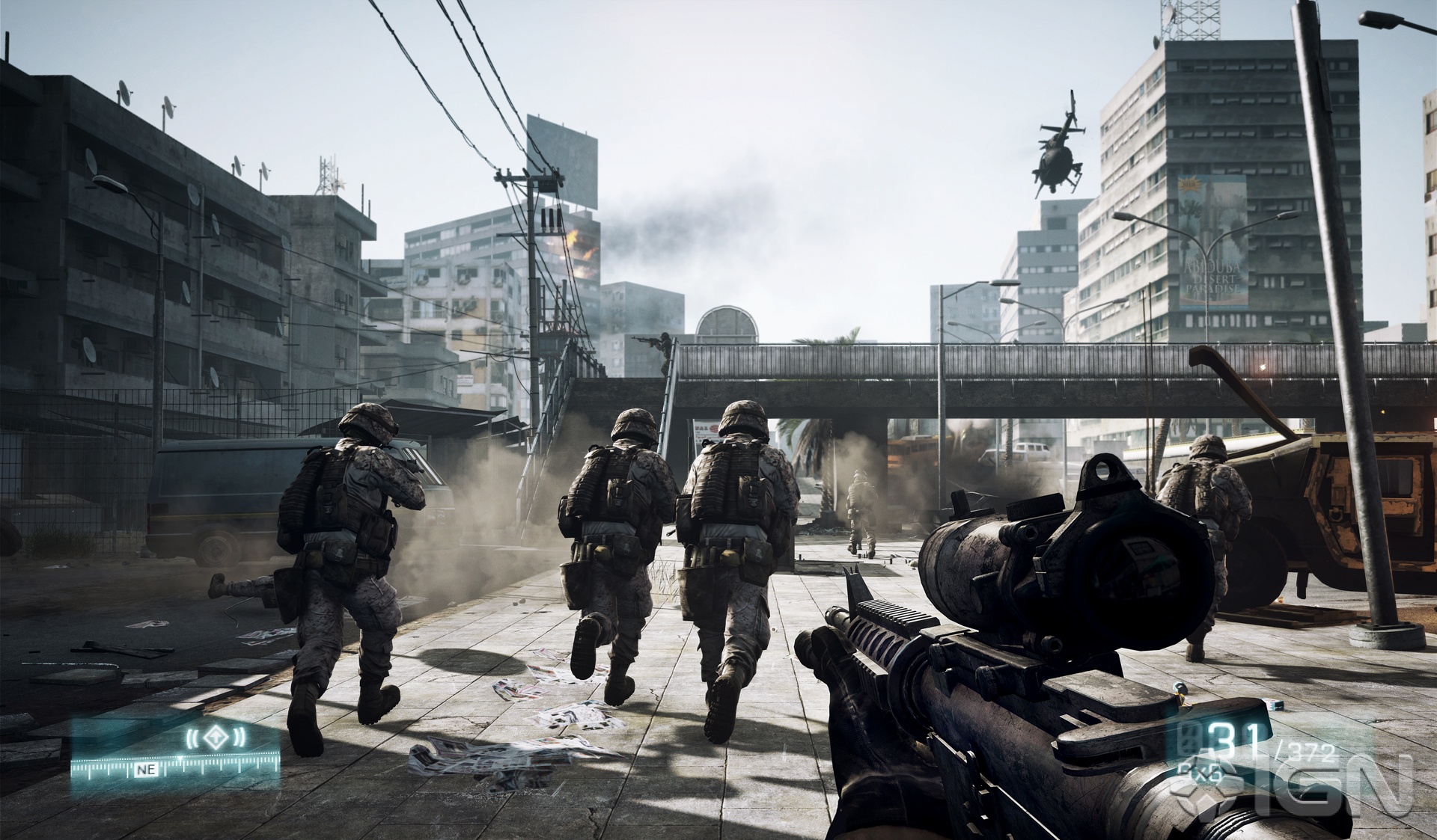
While longtime fans know Battlefield as a multiplayer experience, its campaign and cooperative experiences can't be ignored. For those of you more interested in the single-player campaign than multiplayer, definitely take note. Whereas both Battlefield: Bad Company games added a story underwritten with humor, Battlefield 3 takes a more serious path. Its tale of global threats reads like twenty years of military fiction thrown in a blender and turned into a checklist. WMDs? Check. Russians? Uh huh. Insurgents tucked into Middle Eastern alleyways? Yup. It's all there and woven into levels through the recollections of Sergeant James Blackburn during an interrogation (didn't we see this in Call of Duty: Black Ops?). There's inherent tension in the threat of a terrorist attack, but Battlefield 3's campaign feels like well-trodden ground. 

Battlefield 3's campaign does hit some memorable moments (skydiving, explosions, and entire buildings crumbling), but as a whole it's trite and frustrating. The campaign jams Battlefield 3's multiplayer into a linear box where freedom of choice gets thrown out a non-destructible window. There are only a few buildings to blow holes in, barely any vehicles to take the wheel of, and quicktime events adorn enemy encounters in almost every level. While you can literally crash a helicopter on an opponent's head while parachuting to safety if you so choose in multiplayer, campaign makes you hit X at just the right moment to avoid getting punched -- they're two different games.

The co-op missions surround the events of the campaign, yet feel more enjoyable as individual levels. Working with a teammate leads to more creative approaches of attacks, though the same AI frustrations are in place. While opening doors and during other set animations, AI enemies gain invulnerability. They also have an uncanny ability to pick you out of the crowd. Even while using an AI teammate as cover -- not standard operating procedure, I know -- enemies still find you. 

Additionally, most levels feature a bottleneck where death hits out of the blue. Whether it's a grenade exploding without an indicator, a blast from an unseen enemy, or late-game quicktime event that introduces a new button, the campaign and co-op levels are a minefield of frustration -- especially when cranking the difficulty up to hard. All told, it's a brief affair -- I burned through the single-player portion in under six hours, the co-op content adds another two or three. Also On: X Box 360, PC

Closing Comments
When you shut down Battlefield 3 and let the Frostbite 2-powered dust settle, it certainly has some problems. But DICE’s adoration of and expertise with the online experience permeates every aspect of its multiplayer. Regardless of the narrative missteps or the occasional glitches, Battlefield 3 offers an unforgettable, world-class multiplayer suite so fun that it more than makes up for the package’s shortcomings.

source: ign, wikipedia, games master

Selasa, 08 November 2011

Call of Duty: Modern Warfare 3

Call of Duty: Modern Warfare 3
People love to hate it, but the Call of Duty franchise is successful for a reason. No other first-person shooter has the same flair for visual spectacle in its singleplayer campaign, and few can match its utterly addictive multiplayer. While Call of Duty games have become formulaic at this point, as evidenced by Call of Duty: Modern Warfare 3's muddled narrative and at times frustrating design, Infinity Ward and Sledgehammer Games have refined and polished the Modern Warfare experience to produce the best of the series with the third installment.

Modern Warfare 3 comes to us by way of an older engine, but still looks great. Sure, it's not among the very best out there nowadays, but it performs well. At any given time the screen appears ready to burst with effects and visual madness. Entire battles are waged before you; buildings burn and crumble while a steady flow of explosions batter your senses. This is Call of Duty, and Modern Warfare 3 collects these moments of boom in abundance, presenting them in all their 60 frames-per-second glory.
Call of Duty: Modern Warfare 3

Modern Warfare 3's singleplayer campaign hits many of the same highs and lows as its predecessors. Amazing setpieces serve as backdrops for giant firefights yet again. This is no understatement. Few games retain the crazy roller coaster pace that this does level after level, with brief moments to breathe set between the next eruption of gunplay. The shooting feels extremely responsive and well-tuned, and the battlegrounds challenge your awareness at all times. You're always given different situations that mix-up the gameplay just enough to keep things interesting. The game presents a formidable challenge, as always, on the Hardened and Veteran settings – something that the more hardcore players will want to delve into.

Still, Modern Warfare 3's campaign suffers from a run of the mill story and the patented Call of Duty monster closet syndrome, a common shooter ailment that occurs when infinitely spawning enemies pour from around corners, doors and stairs without end. At several points enemies even appear to completely disregard their own safety if it means they can run past your allies and just shoot you in the face. The story is difficult to follow as usual, and while it does wrap up the arc begun by the previous Modern Warfare games, it isn't ultimately all that interesting or satisfying. Moments of emotional weight fell flat as I found it difficult to muster up feelings of sadness about the death of one named soldier after witnessing the countless deaths of hundreds of other Americans.
Call of Duty: Modern Warfare 3

If singleplayer is good, then Modern Warfare 3's multiplayer is fantastic. Like the other Call of Duty games before it, this entry pulls you in with its persistent leveling system and frantic combat. All of the sixteen new maps are fun to play and, with a whole new slew of challenges to complete, rewards constantly pop up and keep you hooked with the next little endorphin rush. No matter whether I play for five minutes or five hours, multiplayer in Modern Warfare 3 always makes me feel like I'm accomplishing something.

Some of the rewards you're constantly unlocking are killstreaks and perks—series stand-bys—which are a few great examples of how Modern Warfare 3 refines the series. You still unlock weapons by leveling up, but weapons also have levels as well. Leveling up a gun adds Weapon Proficiencies, which are essentially perks for your weapon. These proficiencies take things like the hip fire accuracy perk from the previous games and add it to your weapon unlocks, giving you the ability to focus on other perks when customizing your class.
Call of Duty: Modern Warfare 3

Killstreaks have also been reworked into Strike Packages to bring a better sense of balance and reward to all types of players. You still unlock abilities in Strike Packages by getting kills, but now you can specialize your killstreak rewards so they suit your playstyle. If you're not the type who goes on huge streaks and you're not always watching your kill/death ratio, you can take a Support Strike Package. This package doesn't have rewards that are as offensively-focused as the Assault package, but all kills carry over between spawns. This gives less-skilled players a way to contribute to the fight, and will hopefully give clans and groups ways to better specialize their players into a cohesive team unit. It's a great new feature, and showcases how Call of Duty offers one of the most varied multiplayer shooter experiences around.

The controls feel as good as ever, and that same sense of exhilaration and speed that comes from a great round of multiplayer still exists. Like past Call of Duty games, occasional moments where one team totally dominates the other due to Assault Strike Package rewards still happen, but overall this remains a slight annoyance when weighed against the rest of the multiplayer package.
Call of Duty: Modern Warfare 3

New modes like Kill Confirmed also help keep things from feeling like just more of the same. While lone-wolf players still have Team Deathmatch free-for-all and numerous other older modes, Kill Confirmed changes how the game plays, encouraging team work in ways Modern Warfare didn't previously offer. In this mode, everyone drops a dog tag when they're slain. To get points, you have to not only kill the person, but also collect their tag (you can deny kills by collecting the tags of your allies before the enemy does). The results in an entirely new dynamic, where players must coordinate, play as a team, and attempt to use the dog tags as lures for enemy players.

Combine Kill Confirmed with modes like Team Defender (where each team attempts to hold onto one flag for as long as they can), new private match modes (which you can tweak and customize yourself), as well as many returning favorites, and you have a multiplayer experience you can play for months—if not years—on end. The sixteen maps already span a wide array of settings. And with new modes and the need to switch up loadouts you have an extremely dynamic multiplayer suite. An especially tactics-focused player can sink hours of time into creating classes for specific game types, devising battle plans for specific maps, and developing sports like "plays" for their team.
Call of Duty: Modern Warfare 3

On top of the single and multiplayer campaigns, extra time can be sunk into the cooperative Spec Ops mode. This mission mode from the previous Modern Warfare returns with a whole new set of stages that challenge you in a variety of ways. For instance, you might have to quickly take over a plane, while in another mission you'll be tasked with disarming chemical weapons or silently getting past a large number of enemies. Additionally there's a Survival Mode, where two players try to survive against endless waves of increasingly difficult enemies. It's not exactly original (or zombies), but it's a game type that works well in Call of Duty, and can be played over and over again if you care about getting to the top of those oh-so-precious leaderboards.

The menus and means to interface with Modern Warfare 3 are basically the same, well-laid out system we've seen before, with one major exception: Call of Duty Elite. Elite takes all the stats you care about, like your multiplayer kill/death ratio, etc., and puts it into a format you can easily understand and interact with (similar to what Bungie.net and Halo: Waypoint provides for Halo players). Whether or not you're paying for the more specialized services it offers, you can always check out your performance on past matches, see exactly where you were killed and who killed you, as well as compare load outs and performance like accuracy and flag captures. You can also just look at pictures of maps with all the information such as spawn points for various multiplayer game types, giving you the ability to think about strategies and planning – something that will be super valuable to clans. The sheer amount of available information makes Elite something I can spend far too much time with, and can definitely help you improve your game.

Closing Comments
Despite its flaws, Call of Duty: Modern Warfare 3 takes the fantastic series we’ve come to love over the years and iterates on it with great success. The multiplayer is hands-down the best it has ever been, with more features, more modes and a ton of new levels and ways to interact via Call of Duty Elite. The singleplayer campaign and Spec Ops mode add value to the overall package, creating something that may not be perfect, but is too damn addicting to pass up.

by Anthony Gallegos

Senin, 19 September 2011

Hard Reset: PC

The basic gameplay of the first person shooter is simple: point, shoot and kill. Some shooters dress up the experience, adding story, developing character and creating a believable world to give context to your violent actions. In some cases maybe they even force you to question whether pulling the trigger is a good idea. Hard Reset is not that kind of game. It's about blowing up everything that moves onscreen. Though it suffers from some repetitive sections, especially disappointing considering its short length, Hard Reset's versatile weapon upgrade system and the sheer thrill of some of the combat sequences are enough to warrant giving it a shot.

You know story isn't a priority for Hard Reset when, as soon as a new section finishes loading, a giant line of text pops up onscreen indicating you can skip the cut-scene, even if there's still a minute or more left to watch. Sometimes the comic book-style cut-scenes are fairly lengthy, and without watching them you lose nearly all sense of what's going on in the futuristic world of the not-so-subtly-named Bezoar City. Even if you do watch them, there's little of interest. Hard Reset's story is a tale filled with mostly lame dialogue, flat characters and sinister corporations. When conspiracies are eventually uncovered and allegiances shift, it has all the emotional impact of realizing you mistakenly bought a roll of generic paper towels instead of a name brand.

Hard Reset Video Review

The shooting, thankfully, is developed much more thoroughly. This is a classically-styled shooter in the sense that you need to find health and ammunition pickups scattered around stages and can find secret areas if you poke around environments. Enemies don't wander the world, but instead spawn into combat arenas as soon as you cross an invisible line. It's a monster closet type of game, and a good one.

Hard Reset only throws a few enemy types at you from start to finish. The Teenage Mutant Ninja Turtle-like mouser enemies you fight early on will still be running around in the final battle, though they'll have propellers on their heads. The giant bipedal machines at the beginning that charge at high speeds and try to stomp you at close range will still be around at the end, though they'll have more armor and sometimes rockets. Mixed in are basic gun-wielding and rocket-shooting robot types, as well as two encounters with colossal bosses. Hard Reset's level of challenge increases not primarily through the introduction of many new enemy types, but by combining those you've already fought in greater numbers. While a few more enemy types and surprises could have made for a more interesting journey from start to finish, fighting them remains entertaining thanks to your evolving weaponry and the lethal utility of the environments.

Though you're only given two weapons in Hard Reset, both can be altered with upgrade points earned by making kills and exploring to find special canisters. In addition to the rapid-fire starting weapons you'll get grenade and rocket launchers, a rail gun, homing energy blasts, a shotgun and a variety of alternate fire options. Upgrade the shotgun's functionality and you'll be able to spew out sparkling energy pellets that can temporarily stun targets. The energy mortar normally fires out a crackling ball of electricity that sticks to enemies and eventually detonates. Unlock the mortar's stasis field and it becomes even more effective, capable of dramatically slowing any in the area of effect. Switch over to your rocket launcher (ideally upgraded with cluster missiles), and loose a few shots at the slow-motion enemies for a fireworks display of shredded robot metal. The upgrades add useful functionality and let you fight in new ways, picking up the slack where the enemy variety doesn't.

True to Hard Reset's 1990s roots, there's no cover system and survival is largely dependent on your ability to run to health and ammo pickups. When out in the open circle-strafing and frantically sprinting are frequently required, along with keeping your finger pressed on the fire button. Drawing enemies close to and firing at explosive canisters and electrical boxes can also help clear out combat areas quickly, as it'll pile on the damage in addition to providing a visually pleasing display of flame and sparks. The fast action in Hard Reset is interrupted occasionally by a weird weapon switch timer, which I assume Flying Wild Hog implemented for balance reasons. The effect prevents you from switching from one weapon to another until a cooldown timer for the reload animation has expired, which becomes more apparent after using the more powerful weapon types. In frantic fights, such a limitation can be frustrating, through it eventually becomes tolerable.

Hard Reset Weapons Video

By the time you've unlocked a good chunk of the arsenal, the game abruptly ends. Hard Reset can be completed in only a few hours if you select the easier difficulty settings, though it's clearly meant to be played multiple times. After completing the story an EX mode is unlocked where you can start again with all your upgrades intact, allowing you to continue to expand your arsenal. This certainly makes things much easier, especially if you want to test out the Hard and Insane difficulty levels.

Though the story isn't memorable, at least the ficitonal world looks pretty. You shoot through abandoned lots slick with rain, under rows of floating cars, bright neon ads and steam pipes venting gases across a futuristic nighttime city. The explosions are bright and colorful, and the flickering lighting effects caused by events like your gun's energy blaster striking at skittering waves of murderous enemies add to the excitement. The designs of each level do tend to blend together, but anyone with the hardware to max out the settings here will be pleased.

Closing Comments
Though a limited in many ways, it's still easy to have a good time with Hard Reset. It's a classically styled shooter where your main concern is how to blow stuff up as fast as possible without losing all your health. The disposable story and flat characters shouldn't be surprising for a game like this, but other issues like a the lack of enemy variety and short overall length are disappointing. Despite that, the versatility of the weapon system and flashy visuals make Flying Wild Hog's product exciting from beginning to end. If all you're looking to do is shoot at things and watch them break apart into pretty pieces, you'll get what you want in Hard Reset.

by Charles Onyett

Kamis, 15 September 2011

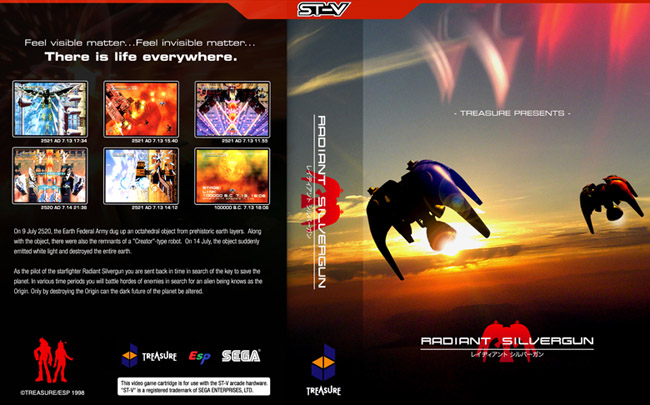
Radiant Silvergun Review: 360

As long as there have been video games, people have dodged lasers and blasted aliens with spaceships. I am both surprised and heartened that such fare remains fun today in games like Radiant Silvergun. Originally released in 1998, the vertically-scrolling shooter finds its way to Xbox Live Arcade with modern conveniences like online multiplayer and high-definition visuals. Developed by Treasure, the same guys we have to thank for the amazing Ikaruga, Radiant Silvergun still impresses with its clever gunplay.

Radiant Silvergun attempts to set up a story with an anime intro sequence, but the convoluted exposition is inconsequential to your enjoyment of the game. There are bad guys swarming you and shooting them down proves fun enough to provide all the motivation you'll need.

Closing Comments
Radiant Silvergun has a lot to offer: you can play it like a manic shooter and enjoy the weapons and skillful dodging, or you can make it more cerebral and go for the ridiculous color combos. Either way, you're getting one of the very best 2D shooters ever made. This is one of those games that slowly reveals more and more of itself to you through repetition. Put in the time, and it will make you feel like a badass.

by: Daemon Hatfield

Kamis, 11 Agustus 2011

Insanely Twisted Shadow Planet: X360

Anyone itching for a Metroid-style adventure will want to dive into Insanely Twisted Shadow Planet. From the comfort of your flying saucer, you'll explore a bizarre alien world, solve puzzles, and find useful tools that grant you access to previously inaccessible areas. This is a fantastic game with beautiful animation -- I only wish there were a bit more of it. Insanely Twisted Shadow Planet took four years to make, but it only takes a few hours to finish.

A dark, malevolent force has invaded your solar system and taken control of your world. As the lone survivor of your alien race, it is up to you to fly into the heart of the parasite and send it packing. This planet is brought to life by terrific animation. As I explored my surroundings I found myself gazing off into the distance behind my ship to admire the detail and subtlety. This is a truly alien world, devoid of anything remotely human.

The sound design is also incredible, from the low frequency moans of the giant bosses to the sci-fi bleeps and bloops of your ship. There is a terrific orchestral score that plays during cut scenes, but otherwise your journey is accompanied only by eerie, ambient sound effects.

If you've played any "Metroidvania" games, Insanely Twisted Shadow Planet will feel very familiar to you. There is a large map for you to survey and you'll do a fair amount of backtracking as you upgrade your ship with gear that will open what were previously dead ends. A claw arm will allow you to pick up rocks that might be blocking your path, for instance. The tools are all fun to play with and are doled out at regular intervals. Combat punctuates the exploration, including some memorable boss fights.

Insanely Twisted Shadow Planet is unfortunately one of the shorter games I've played this year, and the pacing is a little off. I didn't realize I was fighting the final boss until I saw the credits immediately after – it's missing a big climax. When I finished the campaign I had explored the map to 88 percent completion. You are free to return and finish finding all the upgrades and concept art, but I wasn't motivated to do so. It took me four or five hours to complete the game.

Outside of the campaign there is an interesting multiplayer mode for up to four players locally or online. It's a survival game called Lantern Run where each player drags a lantern through randomly-generated caves while trying to outrun a tentacled behemoth that is slowly closing in on the team. Lantern Run is a nice diversion but not something I'll be investing huge amounts of time in.

Closing Comments
Insanely Twisted Shadow Planet leaves you wanting more. With such a well-conceived and beautiful world to explore, it's a shame we can't spend more time in it. But a great short game is more welcome than a mediocre long one, and I do highly recommend you investigate Insanely Twisted Shadow Planet. Despite its brevity, it left a lasting impression on me.
by: Daemon Hatfield

Kamis, 04 Agustus 2011

Galaga Legions DX Review

On paper, I should be in love with Galaga Legions DX. I'm into 2D shooters, retro games, pixel graphics, and heated leaderboard competition. Galaga Legions DX has all of this, but it's missing something more important: hooks. It doesn't get its hooks in me.

The goal is still blasting waves of incoming Galaga aliens, as it has been for 30 years now, but Legions DX is a much faster game than the original. The clock is always ticking, and you'll want to finish as many waves as possible before time's up so you can post a respectable score to the leaderboards. That's what Galaga Legions DX is all about: clearing your screen as quickly and efficiently as possible so that you can spend the maximum amount of time with the 'endless' final round where points are doubled.

But after a game, I don't find myself particularly interested in my score or trying to better it. Though there are many different areas of space to play in, they're all just five levels long, and the only things that change are the enemy patterns. So after one game you'll have experienced most of the gameplay Galaga Legions DX has to offer. There is nothing to work towards, save for a higher score. And while that is often more than enough for me (in games like Geometry Wars or Pac-Man Championship Edition DX, for instance), when I finished a couple rounds of Galaga Legions DX I was ready to move on to other, more addictive games.

What's New?

Your satellites can no longer be placed around the screen -- they're stuck by your side.
Slowdown effect when you are about to collide with an enemy.
Official Championship Score Attack Tournaments held periodically by Namco.


There is some strategy here, such as Galaga Leaders that will destroy an entire squad when defeated and bombs that will take out many enemies at once. Flight lines show you ahead of time where enemies are entering the screen and the path they will take. But it's not enough. It's also not a giant leap beyond what the first Galaga Legions offered. This is a slightly refined version of the same game. If you weren't sold the first time around, DX isn't likely to win you over, either.

Galaga Legions does provide the delightful ability to capture large swarms of enemies that will fight alongside you. But it is missing an "OMFG!" moment like the ghost trains in Namco's Pac-Man Championship Edition DX.

The best reason to play Galaga Legions DX is for the laser light show and super cool retro filters. There are six different visual types, all of which are very attractive. Once you've seen them all, though, your motivation to keep playing may drop significantly. It did for me.

Closing Comments
One round of Galaga Legions DX will show you about all it has to offer. It is gorgeous to behold, but there isn't much to sink your teeth into. If you liked Galaga Legions you'll get more of it here, but it still doesn't offer enough perks for me to want to enlist long-term.

by Daemon Hatfield

Selasa, 19 Juli 2011

Bangai-O HD: Missile Fury: X360

Bangai-O HD: Missile Fury: X360Developer Treasure is a name unfamiliar to many, but those that recognize it knows what they're about. Over the last couple decades they've made some of the best bullet-hell shooters (shooters known for filling the screen with enemy fire) ever. For many the very words Bangai-O are enough to get you excited, as the series has consistently delivered intense and absurdly fun shooters. And you should be excited – Bangai-O HD: Missile Fury is as awesome as it is insane. Bangai-O HD is not a standard bullet hell shooter. Each level plays completely differently. The layouts vary from standard left to right designs, to closed in arenas ala Geometry Wars, to hectic close quarter fights, to vertical levels where enemies rain down.


The levels have different objectives, though they all revolve around destroying everything in sight. The level design is great and Missile Fury plays like a very untraditional shooter. Some missions require you to use only a specific powerup or move. In one mission I had to dash into giant soccer balls to get them to ricochet into enemy robots. It was rad.

Bangai-O HD: Missile Fury is overwhelming. This is usually a good thing, but it is occasionally confusing. There's so much crazy crap on screen that at some points it's impossible to tell what's going on. On numerous occasions a coworker walked by my desk, stared at the screen and asked, "What the hell is happening?" And every time I could only respond with, "I don't know!"

Normally a game like this is something I can only recommend to the masochistic, but Bangai-O HD doesn't punish you for sucking. The game progresses linearly, requiring you to complete missions sequentially. However if you lose three times in a row, the game opens up the next level. You still get punishing difficulty, without the frustration of halted progress. And for bullet hell fans, three rounds are the right amount of tries to beat most of these levels.

In addition to the lengthy single player, every mission in Fury mode can be played cooperatively with another player either locally or over Xbox Live. There is also a level editor that allows you to create your own stages. I didn't have the patience to suffer through the unintuitive and clunky design of the editor, but the tools are there to make massive levels and share them online, which is pretty awesome for those who have the skill and patience. The previous Bangai-O inspired some incredible user made stages, many of them more fun than the game's built in levels, so I can't wait to download more this time around.

Closing Comments
Those of you that know of Bangai-O are probably already playing Bangai-O HD: Missile Fury. For the rest of you on the fence, this game works because it doesn’t restrict you, despite its intense difficulty. The co-op features can make a lot of the levels easier, and a lot more fun, too. The game is confusing, and hectic, more so than other Treasure shooters, but it's also one of the funnest bullet hell (missile hell? Laser hell? Soccer ball hell?) shoots I've ever played.

by:Jack DeVries

Section 8: Prejudice

Section 8: PrejudiceSection 8: Prejudice is an underdog story – a small developer (in this case, Timegate Studios) trying to fulfill the promise of its original idea while making the transition from retail to budget downloadable title. It has a cool hook in its "soldiers fired from a space cannon" premise. It brings a retail title's worth of modes and content to a budget title. The pieces are all there. But Section 8: Prejudice can't seem to fit them together into something more than sort-of interesting. Section 8: Prejudice is the sequel to 2009's Section 8, which introduced, uh, Section 8: a group of cybernetic crazy people fired from orbit into battle wearing nothing but their armor.


I said it was a great hook.

At its heart, Section 8 was a multiplayer-focused affair, with 32-player objective-based matches. It was an FPS that married elements of the Battlefield series with the ardently-worshipped Tribes games - players jetpacked over vehicles and mechs while securing control points and performing other tasks randomly assigned over the course of a match.

Section 8: Prejudice seems poised to correct the original game's main failings, like a mostly non-existent single player element and a certain generic lack of identity outside of the dude-bombardment mechanic. Prejudice promises a lot. Timegate have added a new wave-based survival mode for four players called Swarm. There's also a "full" single-player campaign in Prejudice, with more of a story to it than the tutorial-in-everything-but-name from the first game.
Section 8: Prejudice
At least, I think there was supposed to be a story to it. While Section 8: Prejudice starts with an interesting idea – the original military hard-men used to tame colonial space were forcefully decommissioned by Section 8's precursors, and now they're back and pissed about it – it barrels headfirst into cliché territory and doesn't look back. Playing through Prejudice's uninspired level design, I can see why they'd want to get through it as quickly as possible.

Section 8: Prejudice's campaign feels like it was tacked onto the multiplayer as an afterthought. It swings from one worst-case-scenario to the other. There's the totally mindless point A to point B trek requiring you to slaughter AI bots thrown in with little thought to placement or encounter design. Then there are the clear "this is training for multiplayer situations" scenarios requiring you to hack terminals or repair vehicles for no discernable reason. While you'll be given different tasks, every mission feels similar.

Section 8: Prejudice shifts over time from repetitive but easy, to repetitive but frustrating. Neither is an especially good thing, but one is easier to overlook than the other. Prejudice doesn't challenge you by clever use of established rules and play. Instead, it contradicts previously demonstrated convention, spamming missile turrets that do much greater damage, and producing enemies whose accuracy is close enough to perfect so as to be indistinguishable from it (and who can take more punishment than the combined forces you've murdered to meet them).
Section 8: Prejudice
The mobility options provided by your suit's jetpack and dash ability start as overkill for vastly outmatched enemies. They end as insufficient allies in the face of armored gods that look an awful lot like those guys you killed without thought an hour or two before. This is also exacerbated by controls that feel stiff and slow to respond in comparison to other shooters out there, even when you've used your special lock-on ability to nail your focus to a particular enemy for a limited amount of time.

If Section 8: Prejudice's shooting had the oomph of a better game, this would be less of a problem, but there's a "putt-putt-putt" to most of the weapons. There are tons of weapons, with multiple ammo types for each, but shy of their relative strengths against vehicles, shields, or armor, most of them blur together.

This carries over into Conquest, the returning objective-based versus mode in Section 8: Prejudice. Gunfights in Prejudice feel anti-climactic, regardless of the subject of climax. The point system is a plus, at least. Completing objectives and killing enemy players will earn currency you can use to call in supply points, turrets, and vehicles midgame, which all drop in appropriately given the setting – vehicles arrive via dropship, turrets and support stations are fired from orbit into the combat theater.
Section 8: Prejudice
The pieces are there, but Conquest never really gels. Even while I was riding around in a mech that I called down, plucking members of the enemy team from their bikes and beating them to death with said conveyances, I was bored more often than not. Picking a spawn point from orbit seems like a great deal of freedom at first, but after a few minutes, as control points have been taken, most of every map is covered by anti-air fire that will destroy you without fail should you decide to chance it. This results in too much time spent sprinting from a safe spawn point to where something is actually happening, where you will in all likelihood be swarmed by bots before you can make a meaningful contribution to the cause.

If there's one bright spot remaining in Section 8: Prejudice's fading star, it's the wave-based team survival mode, Swarm. In Swarm, the so-so controls and ho-hum shooting are minimized somewhat by the few-against-many thrill that this game type inspires so effectively. All the elements of Conquest are there, but with a clear focus and narrowed battlefield, it's much more fun. Less can be more.

Closing Comments
If this were a contest to see what budget game could look the most like a full-priced title, then Section 8: Prejudice would be an impressive release. Prejudice certainly does a lot – it just doesn’t do very much well. With a few friends, the Horde-alike Swarm mode could justify Section 8: Prejudice as a purchase during the slow time of the year if you’ve exhausted your other, numerous options. Regardless of its status as a downloadable title, Section 8: Prejudice doesn’t do enough well to make it a must-play. In the morass of other, better shooters (especially on PC), it feels destined to burn up in the atmosphere, rather than establish itself with a community.

by: Arthur Gies

Operation Flashpoint: Red River: X360

Operation Flashpoint: Red River: X360It's a military shooter set in Tajikistan, but you know where it's really set. Red River's another one of those acutely modern combat games most of the games industry seems obsessed with right now, but importantly it's not one you can beat by running forward and spraying bullets everywhere. This is a game about caution and teamwork as much as it is personal accuracy, and in such melodramatic, ludicrous times for shooters its stern, unforgiving tactical violence is a breath of fresh air. Unfortunately that breath threatens to lose its refreshing tang, as Red River quickly suffers from a shortage of the gloss that characterises its stupider peers. It's entirely unfair to expect every shooter to enjoy the sky-high budgets of Call of Duty, Medal of Honor, Homefront et al, or indeed to spend the
resources it does have on spectacle and set pieces, but that doesn't really excuse spending a good portion of your in-game time sat motionless on a long jeep ride while your commanding officer apparently reads aloud every last entry in Mr Naughty's Big Book Of Naughty Swears for his own amusement.

This guy, Knox, is by far the most talkative character in the game - primarily because most everyone else is either just barking or acknowledging orders. He's voiced by the bloke who played Apone in Aliens, and here he's playing pretty much the same hard-ass soldier, only a whole lot more foul-mouthed. What's initially entertaining, thanks to inventively weird swear-combos and Knox's oft-preached 'rules' (which introduce key combat advice within a more convincing pseudo-military context than a tutorial or loading screen message), swiftly becomes grating. One of the game's greatest follies is bookending so many of its missions with long jeep or chopper rides, in which you and your three squad-mates, either controlled by other players or puppet-mastered by AI, sit in silence while Knox rants away endlessly to himself.

At a guess, the intention is to evoke the waiting around and downtime US soldiers in the Middle East often face. Certainly, it's noble to scrub away the fake glamour and macho nonsense that so many other shooters opt for, but there's still to a debate to be had around whether such tedium is suitable for an action videogame. When a mission ends not with a bang but with an incident-free five minute jog back to an extraction jeep that surely could have just driven up to you instead, followed by yet more sit'n'waffle from Knox, it's hard not to think that a few priorities got lost in translation.
Operation Flashpoint: Red River: X360
This quite possibly stems from the dilemma at this new Operation Flashpoint's heart, its inward tussle about what it wants to be. It's got its eye on a middle-ground between the ease of Call of Duty and the patient caution of the veteran PC soldier simulation whose name it bears. For the most part, it finds one. It's not sadistically punishing and it's certainly not hyper-realistic, but you'll quickly learn that a couple of bullets is all it takes to leave you dead or dying (the latter can be fixed by a squad mate's medkit, if they can get to you safely) and that not finding cover during a firefight means certain doom. Fights are slow and tense, a matter of picking your moments and ordering your squad to diligently cover holes in your offense and defence.

At the same time, it's still noisy and explosive, an involving action game against smart and deadly foes. It's more accessible than an Operation Flashpoint game ever has been before, but while veterans of the original (and of the spiritual sequels, the ARMA games) will inevitably find it too lightweight rest assured it hasn't sacrificed its every challenge to the dark god of dumbing-down. This is a game where every last enemy is an incredible threat; jog cheerfully around a corner rather than quietly scope it out first and the guy waiting on the other end will put two in your skull before you've even had a chance to raise your weapon.

At some points, this tension is extreme, for both good and ill. The regular long runs between objectives are largely, tediously without menace, but once in a while a lone insurgent or soldier will unexpectedly pop out from behind a rock or stone hut and create merry hell. Don't take anything for granted is presumably the message; don't make us do quite so many long, boring runs is perhaps the only sensible reply.
Operation Flashpoint: Red River: X360
The excessive amounts of downtime can be alleviated by playing the game in co-op with 2 to 3 others, which is quite clearly how it's supposed to be played. You can instead play it through as a solo game aided by AI, which is impressively capable. While the AI is irritatingly short on autonomy, as long as you regularly give them orders (using a reasonably slick radial menu, which provides easy access to around 16 different commands) they stay pretty much on the ball. Or, if you give them reckless orders such as 'rush directly into that enemy compound' or 'get over here and heal me even though there are a thousand insurgents standing next to me', make terrible, terrible mistakes - for which you have only yourself to blame. The AI could certainly stand to be sharper, most especially in terms of realising when an objective's been completed and thus they should now regroup with you rather than lurk uselessly around the rocks you sent them to earlier until explicitly told otherwise, but anyone accusing it of being stupid most likely has been giving it stupid orders.

Co-op is where it's at, however. It's far better to shout at your sniper to hole up on that roof than to awkwardly place a cursor over it and hit a few buttons to send a robo-man wandering over. It's also far better to approach one of those long, boring runs by saying "you watch left and I'll watch right" or "did you watch Dr Who last night? It was that one where Amy turns into a Dalek" than to silently sprint 600 metres until a guy pops up from behind a ruined car and shoots you dead while your computer-controlled chums are still ambling 100 meters behind you. Humans make what can be a rather sterile, repetitious affair an awful lot more colourful, even if they're not enough to entirely create the diversity and fluidity Red River really needs. Even when a more advanced and organised enemy force is introduced part way into the 12ish hour campaign, the pace and combat is broadly unchanged even though the intensity steps up. Red River essentially models a tight, tense and tactical combat encounter in the contemporary Middle East, and models it very well - but then repeats it ad infinitum, often with only really cosmetic changes.
Operation Flashpoint: Red River: X360
Sometimes, the cosmetic changes are enough. The sweeping, vast backdrop of arid mountains is a regularly spectacular sight, though there's a certain sadness to your movement being locked to only a very small section of the wide-open terrain. Roam too far from the prescribed road and you'll be warned about going off-mission, followed by insta-death if you persist in going AWOL. Perhaps, on PC, someone can hack freeform movement back in - but alas there is no official game editor at present, which means the impressive engine's full potential as a sandbox soldier sim may never be met.

Speaking of PC, we've played the game both on that and on Xbox 360. While this correspondent admittedly favours PC where possible, it must be said that both visually and in terms of combat aptitude Red River is a better experience there. The occasional aesthetic flurries, such as water cascading down a towering dam or sunset across an open desert, are that much more beautiful, while fighting distant foes is a completely different affair. What looks like three lumpy dots at 720p on an HDTV is unquestionably a man with a gun on a reasonably high-res PC, which means you can be a whole lot more accurate. In a strange way, this can be to the game's detriment as much as its improvement. This way, any of the four player classes (the all-rounder Rifleman, the snipey Scout, the explosive Grenadier or heavy weapons guy the Auto Rifleman) is capable of being a sniper of sorts, which perhaps slightly undermines the game's emphasis on the less long-range classes using suppression to keep enemies at bay while the more accurate fellows pick them off. Still, feeling like a capable soldier with a pin-sharp eye beats firing wildly at distant bushes and hoping you hit someone any day.

Special note should be made, incidentally, of the Fireteam missions, a selection of more openly videogame-esque bonus challenges. Dispensing with the drawn out travel and endless, tiresomely sweary jabber of the main campaign, these focus on shorter, tighter, all-action engagements (scouring a dense village for enemy munitions dumps, escorting a convoy through hostile terrain while performing guerrilla repairs amidst the gunfire) which reward skill with points and league table spots. While the core missions are long, drawn-out affairs you're often keen will finally wrap up soon, these have more of a race against time, against all odds feel and in turn offer the variety that's muted by the repetition of the campaign. Also On: PC, PS3

Closing Comments
All told, Red River just about achieves its objective - an engaging halfway house between soldier simulation and improbable heroics, and a slick, smart co-op modern warfare experience. If only it had trimmed down the flabby downtime and the reams of prattling fratboy dialogue which dominate its campaign, and instead pursued more tactical variety, we'd perhaps be looking at something exceptional. As it is it's merely capable, with occasional flashpoints of brilliance.

Conduit 2: WII

Conduit 2: WIIThese are dark times for Wii owners. Sub-standard multi-platform ports aside, there just isn't much to do with the system. Nintendo's own development teams seem to be MIA and third party support has all but evaporated. Yet Sega and developer High Voltage Software have returned to Nintendo's motion-based console for a sequel to The Conduit, one of the few examples of a traditional first-person shooting game really working on Wii. Conduit 2 still struggles in a few key ways, but the overall experience is one that many will find satisfying, particularly those who only own a Wii. The story of Conduit 2 picks up where the last game left off, with lead character Michael Ford chasing the villainous John Adams through a portal-like "conduit." The single-player game, which lasts about five to six hours, not counting a few bonus levels, focuses mostly on this pursuit.


Adams wants more power, and seeks to exploit an alien race's abilities to get it. Ford must stop him. The concept isn't exactly complicated by any means, despite a couple twists, and both Ford and Adams never evolve beyond a very generic hero/villain dynamic. In other words, you're here for the action.

Sarcastic in-game banter between Ford and his mentor Prometheus does give the game a bit of humor that is missing from some FPS games. The developers' also frequently insert nerdy, insider jokes about gaming design and even pop culture in general, reminding you not to take a game about presidential conspiracies and alien invasions too seriously. That won't stop you from groaning at some awkward dialogue, dull plot developments, and a truly "WTF" ending, but it helps.
Conduit 2: WII
The art direction in Conduit 2 is truly excellent, and the chase between Ford and Adams will take you from the stunning caverns of China to snowy Siberian hills. The game's brevity is the only thing holding back more diversity, it would seem, which is unfortunate since one of the most thrilling parts about Conduit 2 is seeing what the artists think of next. Creature design is generally well done, though you'll start to feel like you're fighting the same guys even though they look slightly different.

Particularly annoying is High Voltage Software's obsession with small, ankle-biter enemies that swarm you and more or less require a physical beating to defeat. If you're playing with a Wii Remote, you're going to get annoyed because doing melee attacks isn't all that convenient. Though a slight push forward with the remote will cause Ford to swing his rifle, it's tough to do so without causing your aiming reticule to move. Those of you used to running, gunning and hitting might be a bit disappointed.

While the locales you're fighting in feel fresh and creative, the actual game progression isn't quite so fortunate. The designers deserve an immense amount of credit for keeping things moving and allowing you to find your way through levels reasonably fast. Barring searches for various bonus items that can earn you unlockable items or cash for the in-game store, you'll always either know exactly where to go or find your way reasonably fast. But the vast majority of your time in this game is spent doing the same thing. Hit the switch, blow something up, get to the cutscene. This is a complaint that could be leveled at many FPS games, so it's not as though Conduit 2 is alone in this regard, but the lack of variety does make things feel generic at times.
Conduit 2: WII
What's most disappointing is that the game does feature a cool, on-rails shooting sequence towards the very end that made me wonder why we didn't see more like it -- and earlier. You will also certainly remember the boss fights -- particularly the game's first one, which is thrown at you earlier than you might expect. They're big, they're epic, and they're a lot of fun. More, please.

Control has always been one of Conduit's strengths. High Voltage Software, unlike many developers, actually understands Wii's capabilities and has created a FPS game that takes those functions into account. What's important to note here is that the game features more customization than most shooting games, particularly those not on a PC. A whole range of options, from turning speed to button layout to the way the game reacts to your reticule movement, mean you can find a way of playing that makes sense to you - if you're patient. The truth of the matter is that it can take a lot of tweaking to make this game start to feel like home. If you don't like the defaults, you might be searching for a happy medium for a while.

When all else fails, plug in the Classic Controller Pro. In doing so I found I was giving up a great deal of accuracy for control scheme familiarity, but that wasn't necessarily a bad thing. When dealing with the aforementioned ankle-biters, this was a welcome sacrifice. A firefight meant switching back to the Wii Remote for precise headshots and the invaluable target-locking function, which gives you some level of assistance in aiming.
Conduit 2: WII
The single-player portion of Conduit 2 is certainly an uneven experience. The story is lacking while the interaction between some (not all) of the characters is quite entertaining. The gameplay, while action-packed and viscerally entertaining, lacks the diversity and creativity that Wii games so desperately need to stand out from the pack. Conduit 2 is fun, but it's not going to blow you away. Adding in the multiplayer, however, changes the equation considerably.

In some ways, the multiplayer parallels the single player experience. It's not reinventing the wheel, and it will feel familiar. But that doesn't change the fact that it plays well and that it's fun. There are over a dozen stages and a dozen modes for up to twelve players to play through, online. If you have enough friends or rivals, you can set up private matches with a variety of customized options. High Voltage has also thought of those looking to play with friends at home. Conduit's split-screen mode will not only allow for competitive battles but features "Invasion" mode, which is your now-standard "fight waves of enemies" mode.
Conduit 2: WII
My time with Conduit 2's online mode was reasonably smooth. While the frame rate isn't perfect, it's actually better in some ways than the single-player experience. During the campaign, the action would radically shift from silky smooth to choppy depending on what was happening on-screen. Multiplayer tends to be a more stable affair.

Whether playing online with friends or by yourself in the story mode, Conduit 2 features the ability to customize your character to suit your play style. This doesn't just apply to visual characteristics, but upgrades and power-ups as well. Weapons, armor, the ability to resist types of damage or hold more ammo can all be purchased through an in-game currency. Players can earn this cash by completing the main game or competing online. Certainly there is a lot of incentive and replay value built in to this game, and that's beyond simply fighting opponents.

Closing Comments
Conduit 2 is a worthy addition to the Wii library, and it’s worth playing for its visuals alone. The fact that gameplay and control operate as well as they do speaks volumes for the talent at High Voltage Software. The problem with Conduit 2 is that it never breaks away from doing what other first-person shooting games have done. It’s not telling the most original story, the action doesn’t feature much diversity, and you’re not going to care about the characters. But if you want action, and you want a strong multiplayer title to fire up and explore, you’ve got a winner here.

by: Richard George

F.E.A.R. 3

F.E.A.R. 3The shooter market is definitely a saturated one, rife with derivative titles that rarely buck any trends. But every so often, a title comes along that does things a little bit differently. F.E.A.R. 3 is one such game. A horror and gore-inspired romp, F.E.A.R. 3 approaches the conventions of first-person shooters from a different perspective and successfully mixes together familiar gameplay elements with a unique and authentically chilling setting. F.E.A.R. 3 isn't without its problems, and these problems stop it from being a top echelon shooter. Still, its tendency to go off the beaten path is largely successful and will appeal to shooter fans and horror aficionados alike.


In F.E.A.R. 3, gamers are placed in the role of the genetically-enhanced Point Man, the protagonist from the original F.E.A.R. As you may remember from the end of F.E.A.R. 2, the mysterious female foil Alma forces herself upon that game's playable character -- Becket -- and becomes pregnant with his child. Alma is an evil psychic dynamo manipulated by Armacham, the same company responsible for Point Man's genetic enhancement, but her powers far outweigh his own. Thus, stopping Alma from having this kid is the name of the game in F.E.A.R. 3. Because after all, if Alma is so powerful, who knows what that kid is capable of?

Stopping Alma's pregnancy will be no easy task for Point Man, especially because he's accompanied continuously by the apparition of fellow Project Origin prototype Paxton Fettel, another character fans of the series will be familiar with. One of F.E.A.R. 3's great strengths is that you can actually play as Fettel through any level that Point Man already beaten, which gives a completely different feel for getting through the main campaign.
F.E.A.R. 3
While Point Man is your typical gun-toting badass, Fettel is able to possess enemy soldiers and generally cause an insane amount of havoc. Better yet, you can play the campaign together with a friend locally or online, utilizing both characters' strengths simultaneously.

In terms of aesthetics, F.E.A.R. 3 provides passable graphics that look slightly dated but still get the job done. And the game runs smoothly, lacking the mid-play loading and saving stuttering of its console counterparts. Regardless, you won't mistake F.E.A.R. 3 for a top tier shooter in terms of its looks. On the other hand, F.E.A.R. 3 is a sonically appealing game. The voice-acting is at times over the top, but the sound effects and music add greatly to the scary feel of the game. There's audio nuance everywhere.

Both single player and co-op will require you to work your way through the same eight stages (known as Intervals). Playing through on co-op will allow you to blaze through the game significantly faster than playing on your own, but F.E.A.R. 3's campaign is best enjoyed as a solo affair. Though the game is much more difficult this way, playing on your own maximizes the frights and scares. Co-op is a fun experience in its own right, but should definitely be left for those who have already played through the campaign once before.
F.E.A.R. 3
Mechanically, F.E.A.R. 3 will feel familiar to fans of the FPS genre. Your characters will have access to a number of firearms, explosives and more. Point Man and Fettel can also use their own psychic powers, primarily in the form of time slow-down and enemy possession respectively. The combination of the conventional and the supernatural isn't revolutionary by any stretch of the imagination, but it works well in F.E.A.R. 3. And though the stages are generally linear, there's reason for ancillary exploration, mostly to take in the sheer amount of ambiance present on most levels (not to mention to find collectibles).

If I have one major complaint about F.E.A.R. 3's core gameplay, it's in terms of grenade throwing. It's hard to use grenades in the game with any modicum of accuracy. Chucking grenades way over the intended target is more likely to happen than the perfect toss. Additionally, the AI glitched out on me once in a while, not reacting to my presence when I was clearly in view. None of this breaks the experience, but it certainly hampers it unnecessarily.

But there's good news for gamers who are looking for more than a campaign. F.E.A.R. 3's greatest strength rests in its multiplayer offering. This is no typical multiplayer game, and it shows from the get-go.
F.E.A.R. 3
F.E.A.R. 3's four modes each only allow a maximum of four players at a time, greatly focusing the experience while giving gamers something different and fresh. Each mode has its own unique maps with no crossover between modes, and each mode will appeal to different tasks you want to complete.

For instance, Soul King is a mode that pits gamers against one another as ghastly creatures that can possess enemies around them. As zombies and soldiers do battle on the map, you'll be able to possess them, turning their weapons on fellow players. All dead enemies drop souls, and by collecting souls, you earn points. Hanging on to those points by the time the clock runs out is the real challenge here. On the other hand, Contractions is styled after Call of Duty's Zombie Mode in that you and your teammates are tasked with protecting a static location from incoming waves of enemies, all the while keeping yourself stocked-up with weapons.

But my favorite two multiplayer modes are F**king Run and Soul Survivor. Both are team-based games with a twist. In F**king Run, you and your team have to run away from an ever-incoming cloud of smoke while dodging and fighting enemies. With little room for error and no time to stop, you have to plow through obstacles while ensuring that the smoke never catches up with any member of your team. On the flipside, Soul Survivor is a unique mode where one of the four gamers is randomly made into a ghost that can possess other players. In the time allotted, the goal here is to turn the other three human members of the team into the undead before time runs out.

Everything in F.E.A.R. 3 is wrapped-up into an overarching score system that keeps track of your progress in single player, co-op and online. Points are mostly earned in single player and co-op by completing certain tasks -- menial, difficult and everywhere in between. So you may earn 1,000 points for using cover for 100 seconds, while 5,000 points can be earned for killing 10 enemies in a row without taking any damage. When carried over to the points you're earning online, your profile will be leveled-up, unlocking new perks and skills for you to use no matter where you're playing, whether in the realm of single or multiplayer.

This feeling of progression kept me locked-in to the experience. I wanted to play more, I wanted to play better, and I wanted to see and do everything I could in the game. I found this aspect of the game somewhat addicting. The fact that the game separates how, when and where you earned your points for you to examine later simply gives you more of a reason to come back for more. Trying to beat high scores in single player and co-op can be challenging, but rewarding, and the more you play multiplayer, the more points you'll earn towards making your character stronger and more viable in all of F.E.A.R. 3's modes.

Closing Comments
I really like F.E.A.R. 3. While it’s an experience that’s far from flawless, it’s one of those games that still gives you a lot of bang for your buck. And that’s perhaps what impresses me most. Sure, there are better shooters on the market in terms of gameplay, setting and story, but very few of them give you so many reasons to keep coming back. From the single-player campaign that can be played through twice with two different characters to the co-op campaign that you can play through with a friend locally or online to an incredibly thoughtful multiplayer offering, F.E.A.R. 3 has a lot going for it.

Whether you’re looking for a new, solid shooter to play or something set in a unique, horror-filled atmosphere, F.E.A.R. 3 has something for you. You won’t find the be-all, end-all shooter experience with F.E.A.R. 3, but you’re still bound to have a lot of fun.

by: Colin Moriarty

Battlefield Play4Free: PC

Battlefield Play4FreeWhen we review console games, they're almost always either the retail version or "review code," which is a version close to what comes out at retail (with perhaps some minor bugs that are intended to be worked out before the game is released). For MMOs it's a little different, because frequently major changes are made right up until the release day -- the


day the developer starts charging its customers. For free-to-play games, like Battlefield Play4Free, it's different again for several reasons.

For starters, when reviewing something that can be played for free, what's being reviewed? For a retail game, reviewers are generally answering the question "is it worth the price of purchase?" For free-to-play games there is no up-front price, so instead I have asked myself whether the things available for purchase in Battlefield Play4Free (guns, cosmetic accessories, gadgets to use in battle) are worth their price, whether the impact they make in the game is still balanced for non-paying players, and whether the game itself is worth buying into.

It's different again because while a beta for a subscription-based MMO typically wipes your character before the game releases, most free-to-play open betas, like Battlefield Play4Free's, lead straight into release, keeping all of your character data and progress intact. In fact, they often begin charging players in the beta phase for the microtransaction items as Play4Free has begun to do. In essence, a free-to-play game's open beta is its soft release. Like all MMOs, there will probably be on-going development for Battlefield Play4Free so this review is naturally based on content that is currently available.
Battlefield Play4Free
As an entirely free game, Battlefield Play4Free looks great on paper. It takes three classic Battlefield 2 maps, each with a very different dynamic, and applies some of the Bad Company structure. There are 4 "loadouts" which essentially function as classes -- Medic can revive and heal teammates, Engineer specializes in blowing up and repairing vehicles, Recon can detect enemies in the area or snipe them from afar, and the Assault unit is an all-rounder.

Each map feels more suited to one particular loadout. Karkand, with its emphasis on vehicular combat, is well suited to the Engineer. It's a map full of sidestreets and climbable buildings, with wide avenues for tanks and APCs to storm in and lay claim to the land. The dust makes sniping across long distances difficult.

Battlefield Play4Free

Oman's open spaces and clear skies make sniping very advantageous, though. They also make piloting helicopters and fighter jets a lot of fun. Anyone who has tried flying a plane in a Battlefield game before might already know this, but controlling a jet has a very steep learning curve and if you're not paying attention in a chopper you might find yourself spinning upside-down and sending half a dozen allies to their doom.

Battlefield Play4Free

Sharqi's confined streets play well to the Medic and Assault's strengths and is the most "standard" shooter map of the bunch. There are very few locations which don't leave you vulnerable from some angle, making camping pretty ineffective.

Unfortunately, you can't switch your character during a match, and you can't choose which map you want to play from the menu screen, which means you will often find yourself on a map where you feel out of place. It's also not unusual to find teams highly skewed to one class, which makes being unable to switch to fill a gap all the more frustrating.

In true Battlefield style, each different aspect of gameplay -- flying planes, driving tanks and jeeps, running and gunning -- feels completely different but perfectly natural for what it is. Sniping and on-foot combat naturally favors headshots, while your bullets will do little to most vehicles. In a tank you can fight just about anything but are susceptible to rocket-propelled grenades and other explosives, while in the air you need to steer clear of (or tackle head-on) AA gunners. There are lag issues from time to time, and they can range from the occasional jitter up to freezing for multiple seconds, which in my experience is exactly as long as it takes for a tank to shoot you in the face with its cannon.
Battlefield Play4Free
Pretty much every constructive and destructive action
you perform will reward you with experience and credits. Lots of experience will push your rank up, unlocking points to spend on perks, while credits can be used in the item store to rent weapons and consumables temporarily. Each weapon has its own stats for damage, range, rate of fire, accuracy, and the amount of ammunition it can hold. The "best" weapons can't be rented using credits and can only be obtained by buying "Battlefunds." At the moment, 700 Battlefunds costs you US $4.99, though you can get bonus credits by spending more (US $49.89 gets you 8750, for example). To outright buy the best main weapon for most classes permanently, it'll cost you about 980 Battlefunds which equates to about $7 US.
Some weapons can be used by multiple classes, but even if you buy it on one character it won't unlock for the others. This means that if you wanted to buy the best handgun for each of your -- let's say -- 4 soldiers, you would have to spend about US $28. Unlocking the extra 2 soldier slots costs another 140 Battlefunds each. If you didn't want to own the gun permanently, you can rent it for one day for 140 Battlefunds, or a month for 490. If you wanted to change your "main soldier," which is basically the face of your account, it will cost you 300 Battlefunds. These all seem a great deal overpriced for what you're actually getting. I'd be much more inclined to rent multiple weapons if I weren't essentially paying a large fraction of the price of a full game. And having to pay a few bucks just to change my main soldier (which functionally does nothing) is excessive.

The less-powerful guns can be rented for the earnable credits for up to three days, and quite frankly, the difference between the best Battlefunds-only guns and the rentable-with-credits guns are pretty negligible.

Cosmetic changes like new uniforms, hats and accessories can only be bought with Battlefunds and range from 420 to 900 to own forever, and are sold in five separate slots, which means buying an entire outfit permanently will cost you a minimum of about US $15. There are currently no social hubs (although you can make your character dance), so there aren't many opportunities to show off your pimped-out self even if you decide to drop that kind of dough.

Closing Comments

For Battlefield Play4Free to be worth buying into it will need much stronger social options, more flexibility for switching characters, and a lower cost structure. It also needs a reason for me to want to buy into it in the first place. At the moment there isn't a ranking system, so progress and prowess can only be admired for as long as a match lasts. It all leaves me wondering why, at this point, anyone would choose to spend money on Play4Free when they could essentially get a larger, more complete game for just a few bucks more than the minimum Battlefunds purchase price.

by: Nick Kolan

Yar's Revenge: X360

Yar's RevengeBeing the tender age of 28 that I am, I missed out on the hubbub for Yars' Revenge back when it was released for the Atari 2600 in 1981 due to not quite yet being born. It was one of the best-selling games for that console, though I was only able to dabble with it through emulators and the occasional fan-created homage. Considering the infancy of the gaming industry at the time, Yars' Revenge was a fun little shooter that featured such ground-breaking technology such as diagonal movement, which might sound ridiculous today but was pretty big stuff 30 years ago.


Nostalgia plays a big part in the videogame industry, which is why I really shouldn't be surprised that developer Killspace Entertainment decided to remake the game for today's audience. Yars' Revenge didn't really have an epic fiction to begin with, so Yar's Revenge (with the moved apostrophe) didn't have much to work with in that department. The story, such that it is, tells of a human-like insect girl named Yar, captured and enslaved as a hitman (hitbug?) for an evil race of aliens called the Qotile. After a couple missions, she breaks free of her enslavement, and then starts her rampage against her captors.

The story is mostly told through a comic book-style series of illustrations with subtitles between missions. There is no voice acting and the subtitles disappear entirely too fast, so unless your eyes are quick, you might not catch the nonsensical conversations between Yar and the ancillary characters. Yar also converses with others during the stages, which is absolutely ridiculous, because you have no time to read the text while constantly being pelted with gunfire from all angles. This is one of the rare cases where bad voice acting would be better than no voice acting, especially because it's pretty close to impossible to read the text on a standard-definition TV. No one should be picking this game up for the storyline anyway, but the lack of effort'is pretty glaring.
Yar's Revenge
You'll lead Yar through six stages as she encounters a never-ending wave of bad guys, and you'll instantly realize that Yar's Revenge has pretty much nothing to do with Yars' Revenge other than the name. Yar herself is controlled with the left stick while aiming is handled by the right stick, a control scheme that takes a bit of time to get used to. You'll encounter the same three major types of enemies from beginning to end, and the lack of variety seriously damages the longevity of the game.

Not helping matters is the style of flying. This is an on-rails shooter, so while you can make Yar fly up and down, left and right, and diagonally to dodge incoming fire, you are constantly being shoved along a specific path. Randomly, Yar will change direction, even doing a 180 to start shooting things that are technically behind her. While this is supposed to instill a sense of chaos and underline the odds she faces, it does so for the wrong reasons. The constantly changing background will wreck havoc with your depth perception, making it artificially more difficult to know where the shots are coming from and when to time your movements. It's a nagging problem through all six stages, though you eventually learn to compensate for it.

Still, one thing you cannot compensate for is the fact that the rules governing everyone's laser fire in inconsistent. Sometimes, when part of the environment passes between you and your enemy, your shots will be blocked but theirs will get through. Other times, everyone's shots are blocked. Still other times, everyone's shots get through, but you still won't be able to see what you're shooting. These moments usually don't last for more than a couple seconds, but it's extremely frustrating when it happens.

The environmental problems are an unnecessary challenge, because Yar's Revenge is pretty tough as it is. Even the normal difficulty is no joke, and is definitely not for rookies in the shooter genre. If you've never seen the final boss of older shooters such as Gradius, there is no way you're going to survive the harder difficulties here. This is great news for gamers who bemoan the ease of today's games, so if you've been looking for a challenge, look no further.


Yar's Revenge
If things get too tough, you can bring in a second player for some cooperative extermination. However, co-op can only be played locally, another mind-blowing misstep in the game's design. There are leaderboards and optional challenges, but the lack of online multiplayer hurts, especially given that you can beat Yar's Revenge in under a couple hours.

Graphically, Yar's Revenge is a mixed bag. The comic book-style artwork works well enough, but is awfully simplistic. The environments range from gritty to almost beautiful, and Yar herself is well-detailed, but you're going to be too busy not getting killed to really enjoy the sights. The way Yar's Revenge plays, it should be a less-is-more situation: too much graphical display just makes for distraction, rather than adding anything to the product. You can view the original comic for the 1981 game, which is a nice touch, but like in-mission subtitles, you're shafted if you don't own a high-def TV.

Closing Comments
Yar's Revenge is tailor-made for shooter fans who are seeking a challenge, but at $10, it's too short for me to truly recommend it. There are better options out there, both for XBLA and for gaming at large. For everyone else, you may as well take a pass, as there is nothing else being offered here. Be warned that, other than the names of the alien races, there is basically no connection to the 1981 hit, so it would be a waste to buy it simply for nostalgia's sake.

by:Jon Michael

SOCOM 4: U.S. Navy SEALs

SOCOM 4: U.S. Navy SEALsFans have been waiting years for SOCOM 4 and now that it's finally here they expect a lot from the first party shooter. With a complete campaign and the promise of multiplayer poised to appease old and new fans alike, SOCOM 4 sounds sweet. It is a good game, though it just never becomes a great one. In SOCOM 4 you play as Cullen Gray, the Ops Commander on a five person NATO team, trying to stop a crazy revolutionary from destroying a waterway and taking over an unnamed Southeast Asia
country. Only Gray and Forty-Five, the two playable characters, get any sort of character development. The other three are just there. If you want a better story than "five dudes defeat an entire army" look elsewhere, but the voice acting is well done, even if some of the lines are ham-fisted ("Here's his pen. Make sure you stab him with it.").

SOCOM 4 is a squad-based game with a few stealth missions thrown in. As Ops Com you can issue commands to your team, moving them into position, marking enemies, or making sure the squad keeps it tight as you infiltrate enemy bases. Your involvement in the combat is up to you. However, the game is easier than it ought to be. Your team's very good at their jobs, and the enemy AI is dumb. Unless you're playing on Hard, your squad will automatically kill everyone if you let them. If they die, they can even revive each other. However, unlike games like Killzone, your squadmates cannot revive you (what gives?). When the game did get challenging near the end, or when I upped the difficulty to Hard, I enjoyed the strategy in issuing commands. It became crucial to order a hit on a sniper or tell the team to move from cover before rockets found them. Plus the added difficulty made my squad mates that much more vulnerable, removing their ability to easily revive each other infinitely, making them feel like actual soldiers and not robots.
SOCOM 4: U.S. Navy SEALs
The single-player campaign is fun, with some very tense moments: at one point your team is holding a position, fighting off waves of enemies while staying out of the way of missiles, for example. SOCOM 4 uses sound really well to up the intensity of battles, and the sound of a skull exploding after a well placed headshot is quite satisfying. The stealth missions, though mostly trial-and-error, are a fun change of pace that allows you to play as Forty-Five.

At approximately six hours, the campaign short, though that is unfortunately a standard length for a shooter these days. Whereas games like Battlefield: Bad Company 2 take you all over the world, SOCOM 4 limits you to a small area with a lot of very similar levels. Those levels don't feel restrictively linear, but they're not eye-catching – there are only so many dirt roads lined with underbrush and decrepit bridges I can look at before it starts to feel the same. Texture quality is not consistent through the game. Seeing well-rendered characters standing in a room with furniture that looks like it was stolen from an early PS2 game is jarring. Jungles and cities look nice enough, but characters clip right through the underbrush (where you spend a good deal of your time), and only a few objects in the game are destructible.
SOCOM 4: U.S. Navy SEALs
Outside of the single-player campaign is a set of co-op mission modes. The two mission types can be played on six maps, making co-op nearly as long as the single player campaign. Co-op with three other friends was by far my favorite experience with the game. You can revive each other, scream at each other through headsets to cover you – nearly everything the single player campaign offers. No one is actually the Ops Com, though, so nobody can mark targets or set waypoints, which would have been cool.

Competitive multiplayer for SOCOM 4 has been changed from the previous games, but there are options to make it more like the PS2 versions. I like having this level of control. I like being able to control respawns, health regeneration, or whether players can take cover. For ranked matches, the games are split between new rules, and classic rules, letting you decide.
SOCOM 4: U.S. Navy SEALs
While there are only four multiplayer game modes in SOCOM 4, I enjoyed all of them. Three are standard shooter game types like a team deathmatch (Suppression) and a capture the flag style game mode (Uplink), but Bomb Squad stands out. One member of the team is the bomb technician, complete with Hurt Locker inspired ultra padded suit. Their team has to cover them, as they make their way to three bombs, attempting to defuse them. However, classic mode makes Bomb Squad really hard to win. Matches will sometimes end 30 seconds in because a well placed bullet killed our Jeremy Renner wannabe.

Thankfully, the nine multiplayer maps are more varied than the single player campaign. There are dusty shanty towns, WWII-era bases, jungles, and, my favorite, Rush Hour, a vehicle strewn patch of freeway in the middle of a war torn city. Not all of them are gems, but they're all good.

In addition to your rank leveling up as you play, the weapons you use also level up, earning mods that make them more efficient and powerful. The improved scopes are the most noticeable changes, and can make a significant difference in both single-and multiplayer.

PlayStation Move Support

SOCOM 4 was one of the first games shown off using the Playstation Move controller, and it offers full motion support for both the standard Move controller, and the sharp shooter gun peripheral Sony has been advertising recently. After playing with both, I found myself going back to the Dualshock 3. Using the wand and nunchuk works well enough, similar to how the better Wii shooters control. If you prefer an easier time aiming while sacrificing your ability to turn around quickly, then you've got it. However, I was not feeling the sharpshooter. The game doesn't change the button configuration, making it awkward to slip into cover and pop out of it to aim. That's annoying as hell for a cover based shooter.

Closing Comments
SOCOM has always been one of the more polarizing franchises. Some people just can’t get into it, and that's fine. The multiplayer for SOCOM 4 is solid, and I'm having a lot of fun with it. I wish there were more game modes and maps to make my purchase feel worthwhile. The story mode has interesting squad command gameplay, though I found myself enjoying the co-op missions more because I could actually yell at my sniper to kill the dude with a rocket launcher. If the single player were longer, and the story was worth following there'd be a great game here, instead of just the good one that might get ignored.